Wenda Electronics
A terminal block may look small, but it carries current through every operating cycle. A loose clamp, undersized rating, or poor fit can interrupt an otherwise well-designed system. This guide examines China’s top 10 Terminal Block Connector manufacturers through practical criteria: product range, rated voltage and current, conductor compatibility, mounting options, quality controls, and technical support. The details matter. A control cabinet with narrow wiring ducts needs compact blocks; a vibrating machine may need stronger retention and careful testing.
Hugo Knümann, the Phoenix Contact founder associated with early modular terminal block development, offers a useful historical reference. The following is an editorially phrased principle, not a verified quotation: “Reliable connections begin with sound design and disciplined testing.” That distinction matters when evaluating supplier claims. A polished catalog is not proof of performance. Buyers should check current datasheets, certifications, sample quality, and traceability for the exact model under consideration. Ask about lead times, customization, and after-sales support, too. Small details count. The manufacturers in this overview serve different applications and price points, so no single ranking fits every project. Treat the comparison as a starting point, then confirm specifications against your installation conditions. One caveat remains: published product information may change, and independent verification is essential before procurement.
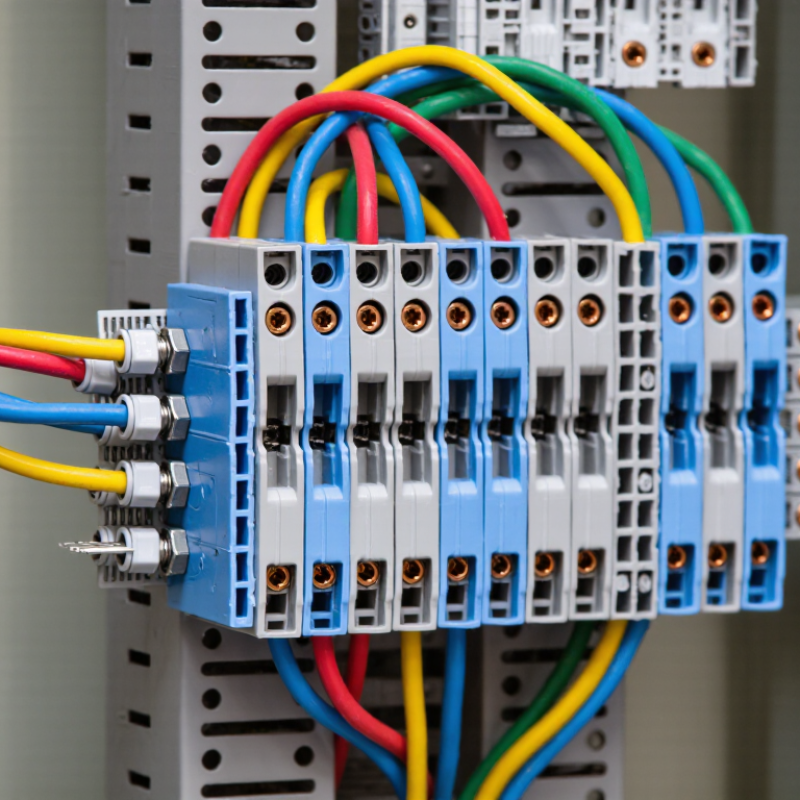
Terminal blocks make electrical connections orderly, inspectable, and easier to service. Screw-clamp types hold wires with a tightened screw, while spring-clamp and push-in designs use spring pressure for faster installation. Barrier blocks separate adjacent terminals, and pluggable versions let technicians disconnect a circuit without removing every wire. Each style has trade-offs. A screw can loosen if poorly installed; a spring connection still needs the correct wire size and preparation.
Their core job is to join and distribute conductors while keeping them secured and identifiable. In a control cabinet, for example, a technician may route sensor wires through labeled blocks, then connect power and grounding circuits separately. Ratings for voltage, current, wire range, temperature, and vibration matter. So does checking the manufacturer’s technical documentation. A neat-looking connection is not automatically a safe one.
Applications range from building controls and industrial machinery to renewable-energy systems and electric-vehicle charging equipment. The International Energy Agency’s Renewables 2024 report forecasts nearly 5,500 GW of new renewable power capacity worldwide between 2024 and 2030, increasing demand for dependable electrical interconnections. Its Global EV Outlook 2024 expects electric-car sales to reach about 17 million in 2024, or more than one-fifth of global car sales. These figures describe broader markets, not terminal-block sales. Still, they show why reliable connections matter. Selection can be less straightforward than it looks.
China’s terminal block manufacturing industry sits within a broad electrical equipment supply chain, serving control cabinets, power distribution, machinery, and building systems. The National Bureau of Statistics of China reported that electrical machinery and equipment manufacturing value added grew 12.9% in 2023, while manufacturing overall grew 5.0%. These figures indicate a strong industrial backdrop, but they do not measure terminal blocks alone. That distinction matters.
Production ranges from compact PCB terminals to DIN-rail blocks with screw, spring, or push-in connections. Buyers should compare rated voltage and current, conductor size, temperature limits, and test documentation. IEC 60947-7-1 provides requirements for terminal blocks used with copper conductors. A specification sheet is useful; a sample test under the intended load is better. Details can be missed.
Tips: Ask for traceable test reports and confirm the exact wire type and cross-section used during testing. Check markings on the product, not only the catalogue. For export projects, verify that the selected standard and certification match the destination and application. A small mismatch in conductor range can complicate installation later.
Industry overview of ten common terminal-block product categories. These rows describe product types, not ranked manufacturers; product availability and specifications vary by supplier and model.
| No. | Product Category | Typical Connection or Function | Common Mounting | Typical Use | Relevant IEC Standard* |
|---|---|---|---|---|---|
| 1 | Feed-through terminal block | Connects conductors through a common terminal path | DIN rail or panel, depending on design | Control cabinets and general wiring distribution | IEC 60947-7-1 |
| 2 | Protective-earth terminal block | Provides a protective-conductor connection to the mounting system | Usually DIN rail | Protective earthing in electrical enclosures | IEC 60947-7-2 |
| 3 | Fuse terminal block | Holds a fuse in a terminal-block assembly | Usually DIN rail | Circuit protection and control-panel wiring | IEC 60947-7-3 |
| 4 | Disconnect terminal block | Includes a means to open or isolate a circuit for testing or maintenance | Usually DIN rail | Measurement, testing, and circuit isolation | Product-dependent; verify the applicable standard and rating |
| 5 | Multi-level terminal block | Provides multiple electrically separate connection levels in one block | Usually DIN rail | Space-conscious control-cabinet wiring | IEC 60947-7-1 may apply to relevant designs |
| 6 | PCB terminal block | Connects field wiring to a printed circuit board | Through-hole or other PCB-specific mounting | Power supplies, controllers, and electronic equipment | IEC 60947-7-4 |
| 7 | Sensor/actuator terminal block | Organizes multiple signal connections; configurations vary by design | Usually DIN rail | Factory automation and machine control panels | Product-dependent; verify the applicable standard and rating |
| 8 | High-current terminal block | Designed for higher current ratings than general-purpose signal terminals | DIN rail or panel, depending on design | Power distribution and equipment supply connections | IEC 60947-7-1 may apply; check the product rating |
| 9 | Barrier terminal block | Uses insulating barriers between adjacent connection points | Panel or equipment mounting, depending on design | Equipment wiring where separated connection points are required | Product-dependent; verify the applicable standard and rating |
| 10 | Spring-clamp terminal block | Uses a spring mechanism to clamp the conductor; it is a connection method, not a single mounting format | DIN rail or PCB, depending on design | Control wiring and electronic equipment connections | Applicable standard depends on product type and intended use |
* IEC references identify standards relevant to specific terminal-block types; they do not establish that every product in a category is certified. Confirm conductor type and size, rated voltage and current, temperature range, mounting requirements, and applicable approvals in the manufacturer’s datasheet.
When evaluating terminal block connector manufacturers, look beyond catalog prices. Check whether the supplier provides rated-current and voltage data, wire-size ranges, temperature limits, and clear installation instructions. Ask for test reports covering contact resistance, temperature rise, dielectric strength, and vibration where relevant. Confirm that samples match the production materials and plating. A neat sample is not proof of consistent batches.
MarketsandMarkets’ 2023 terminal block market forecast estimated growth from USD 4.3 billion in 2023 to USD 5.7 billion by 2028. That growth makes supplier capacity and quality controls worth checking, not assuming. Review factory audit results, traceability records, change-control procedures, and delivery performance. IEC 60947-7-1 is a useful reference for assessing industrial terminal blocks, but compliance documents should identify the exact product family and test scope. No checklist catches every field failure.
Tips: Request a sample and test it with the actual wire, ferrule, and screwdriver used on your line. Check clamping stability after repeated wiring cycles. Ask how the manufacturer handles a failed batch. If the answer is vague, pause. A low quote can still carry hidden costs.
China Top 10 Terminal Block Connector Manufacturers
Profiles of China’s Top 10 Terminal Block Connector Manufacturers
Comparing China’s leading terminal block manufacturers means looking beyond catalog size. A useful profile covers product range, production consistency, and engineering support. Some manufacturers focus on DIN-rail blocks for control cabinets. Others specialize in compact PCB terminals, high-current connections, or spring-clamp designs. These differences affect installation time and suitability for specific equipment.
Details matter. Check the conductor range, rated current, insulation material, and operating temperature for each product family. Ask how samples are inspected and whether drawings show clear dimensions and wire-entry directions. A polished catalog is helpful, but it cannot replace a sample test. Fit a block to the intended rail, tighten the specified wire, and inspect for movement. Small inconsistencies can create real assembly delays.
Profiles should also note customization options, tooling experience, and communication quality. Some suppliers handle unusual pitch or marking requirements well; others are stronger in standard, high-volume parts. Neither is automatically better. Request current test reports and clarify which product models they cover. Manufacturing capability can vary across product lines, so avoid assuming one successful sample represents every series. Comparison takes work. Even a careful shortlist may need revision after testing.
Comparing China’s top 10 terminal block connector manufacturers requires more than checking catalog size. The IEA’s World Energy Investment 2024 estimated that clean-energy investment would approach $2 trillion that year, increasing demand for dependable electrical connections across power and industrial projects. This is a demand signal, not a terminal-block sales forecast. That distinction matters. Compare screw, spring-clamp, and feed-through options by wire range, rated current, temperature limits, and available accessories. Ask for test reports, not just a logo on a product sheet. IEC 60947-7-1 and UL 1059 are useful reference standards, but confirm which product series and ratings each certificate actually covers.
Supply capacity deserves equal scrutiny. UNCTAD’s Review of Maritime Transport 2024 reported that container-ship transits through the Suez Canal had fallen sharply amid shipping disruptions, illustrating why delivery promises can change. Ask manufacturers for current lead times, monthly output, sample availability, and a second-source plan for key materials. Request a recent production audit or a dated capacity statement. Ratings are not enough. A factory may offer hundreds of variants, yet still struggle with a custom marking run or a sudden order increase. I would compare a sample batch against the quoted drawings and packaging details; spreadsheets rarely reveal those small mismatches.
Review rated current, voltage, wire-size range, temperature limits, and installation instructions. Missing details matter.
Ask for reports on contact resistance, temperature rise, and dielectric strength. Include vibration testing when relevant.
No. Confirm its materials and plating match production parts, then inspect more samples if possible.
Use the actual wire, ferrule, and screwdriver from your assembly line. Check clamping stability after repeated wiring cycles.
Review factory audits, traceability records, change-control procedures, and delivery performance. A vague answer deserves another question.
Check that documents identify the exact product family and test scope. IEC 60947-7-1 can be a useful reference.
No. Capabilities may differ between product families, so test each relevant series. I would still recheck it.
Compare conductor range, insulation material, operating temperature, customization, and engineering support. A low quote can hide costs.
This article explores the role of the Terminal Block Connector in electrical systems, outlining its core types, functions, and common applications across industrial, commercial, and infrastructure projects. It also provides an overview of China’s terminal block manufacturing industry, including the range of products and production capabilities available to buyers.
To help readers make informed choices, the article explains how to evaluate manufacturers based on product quality, technical support, certifications, customization options, and supply capacity. Profiles of ten manufacturers offer a structured view of the market without focusing on brand promotion. A final comparison of product portfolios, certifications, and delivery capabilities highlights practical factors to consider when selecting a supplier for specific technical and project requirements.
